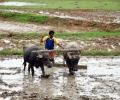
Any long dry spell could cause moisture stress in the standing crop during the crucial maturing stage and also make it prone to pest and disease attacks.
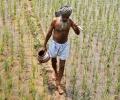
A prolonged break in monsoon rains in most parts of the country is threatening to hit the yield of kharif crops. It could even delay the upcoming rabi sowing. Major agricultural states, such as Maharashtra, Madhya Pradesh, Andhra Pradesh, Punjab, and Gujarat, have witnessed a deficit of 30-80 per cent in southwest monsoon rainfall in August compared to the long-period average for the month. Meteorologists see no big revival in monsoon rains from hereon, though they forecast "some activity" over the Bay of Bengal on September 5-6.
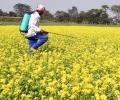
Pulses are most vulnerable to pests and diseases if the monsoon remains patchy for the rest of the season.
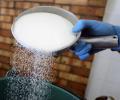
The last few years have been uncharacteristically good for the Indian sugar sector for a variety of reasons. While on the one hand, the weather supported good crop production; on the other hand, the programme to blend ethanol with petrol took off in a big way. The long-pending problem of burgeoning sugarcane arrears almost came down to nil and exports boomed to record highs.
The government is "extremely disappointed" with the latest report of the Moody's rating agency on India's economic outlook. The report, a senior government official said, was highly contradictory and called the rating agency's credibility into question. Referring to the Moody's statement that "India's fiscal strength remains a key weakness in the sovereign credit profile...", the official remarked: "How can my strength be my weakness? Moreover, they are unwilling to have a like-to-like comparison with India."

Tourism is badly affected. Entire apple orchards have been washed away. 2 million people are threatened with loss of livelihood.

Barely days after imposing a 40 per cent export tax on onions to cool down soaring prices, which, in turn, triggered widespread protests across the main growing belts, the Centre on Tuesday sought to mitigate both political and economic tensions gripping parts of Maharashtra. It decided to procure an additional 200,000 tonnes of onions at Rs 2,410 per quintal for its buffer stock from farmers, a rate that is strikingly close to the price at which they were being exported before the 40 per cent duty was levied on August 19. The export price before the imposition of the duty stood at around $320 per tonne free on board (approximately Rs 2,650 per quintal).
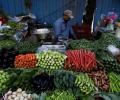
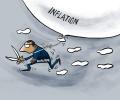
The finance ministry has cautioned that global and regional uncertainties and domestic disruptions may keep inflationary pressures elevated in the coming months, warranting "greater vigilance" by the government and the Reserve Bank of India (RBI). "Russia's decision to terminate the Black Sea grain deal, along with dry conditions in major wheat-growing areas, caused a price spike in cereals. Domestic factors like white fly disease and an uneven distribution of monsoon exerted pressure on vegetable prices in India," the ministry said in its latest Monthly Economic Report for July, released on Tuesday. However, the report maintained, the recent price surge in certain food items "is expected to be transitory". "Tomato prices are likely to decline with the arrival of fresh stocks by the end of August or early September.

India's leading commodity exchange, National Commodity and Derivatives Exchange (NCDEX), and private weather forecasting company Skymet took a significant step towards launching the country's first tradeable weather index on Monday (August 14) by entering into an agreement to deepen their understanding of the impact that weather has on agricultural commodities. The memorandum of understanding (MoU) between NCDEX and Skymet is a profound step in the direction of linking farmers with the weather in a scientific way, according to an official statement. Sources indicate that NCDEX and Skymet will conduct workshops and seminars across the country to educate farmers about how they can scientifically use weather forecasts to hedge risks.

The Ministry of Corporate Affairs (MCA) is contemplating an increase to the existing strength of the National Company Law Tribunal (NCLT) benches to handle the growing case load. The ministry is currently analysing the time taken by each bench to dispose of matters and the total number of cases being handled by each bench. "We need to first determine our requirement, given that the NCLT handles both Company Act and insolvency and bankruptcy matters. "The latter constitutes the majority of the case burden.

Benches of the National Company Law Tribunal (NCLT) should not get into questioning a company's default once it is established by the creditors, particularly financial creditors, for admission to the corporate insolvency process. This is one of the key themes of the draft guidelines for the NCLT, which are being finalised by the Ministry of Corporate Affairs (MCA), a senior official said. According to the official, while the company law matters could involve the "principle of natural justice" and justify extended proceedings to hear all parties concerned, the same does not apply to the Insolvency and Bankruptcy Code (IBC) proceedings.

The El Nino impact on the Indian monsoon typically manifests by way of extended break in rainfall.
Improved monsoon, solid fiscal performance, and capex push by the public and private sectors augurs well for India's macroeconomic stability and growth, the finance ministry's monthly economic review for June 2023 said. But the report said that while India's domestic fundamentals remain strong, negative cross-border spillovers and adverse global developments could act as a deterrent in achieving the high growth path this financial year. "An improved matching of aggregate supply and aggregate demand in the Indian economy underpins the progress made in the control of domestic inflation and the consequent strengthening of macroeconomic stability," the review said.

India's decision to ban the export of non-basmati white rice has pushed up global prices, prompting multilateral lending agencies, such as the International Monetary Fund (IMF), to call for a reconsideration of the move. Though nothing has been spelled out yet officially, sources said, the government might consider requests for government-to-government sale of non-basmati white rice, especially to West African nations where India is a major supplier. Also, traders and exporters of specialty regional rice varieties like sona masuri or gobindo bhog feel that they have been short-changed.

The Rajya Sabha on Tuesday gave its green light to the Multi-State Cooperative Societies (Amendment) Bill 2023. This Bill introduces significant amendments to the Multi-State Cooperative Societies (MSCS) Act. These modifications aim to enhance the transparency and accountability of these cooperatives' operations in a bid to improve governance.
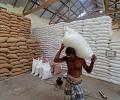
Rising prices of cereals and concerns over rice production in the 2023-2024 crop year due to insufficient rains followed by floods could be the possible causes.

'I'm very much against petrol and diesel....'' 'I travel in an electric car.' 'I have had a really good experience with it.'

Non-basmati white rice accounts for nearly 25-30 per cent of total rice exported from the country.

Usually, turmeric is grown over 290,000-330,000 hectares of land. But in 2022-2023, according to official estimates, there has been a drop of about 10,000 hectares.

Cooler weather meant that demand for milk products and value-added items like buttermilk and ice-cream did not show the usual rise.
 © 2025 Rediff.com - Investor Information - Advertise with us - Disclaimer - Privacy Policy - Sitemap - Feedback - About us - Terms of use - Grievances